


Custom Home Office Garden Room Ideas
- Mark Moody
- Apr 6
- 6 min read
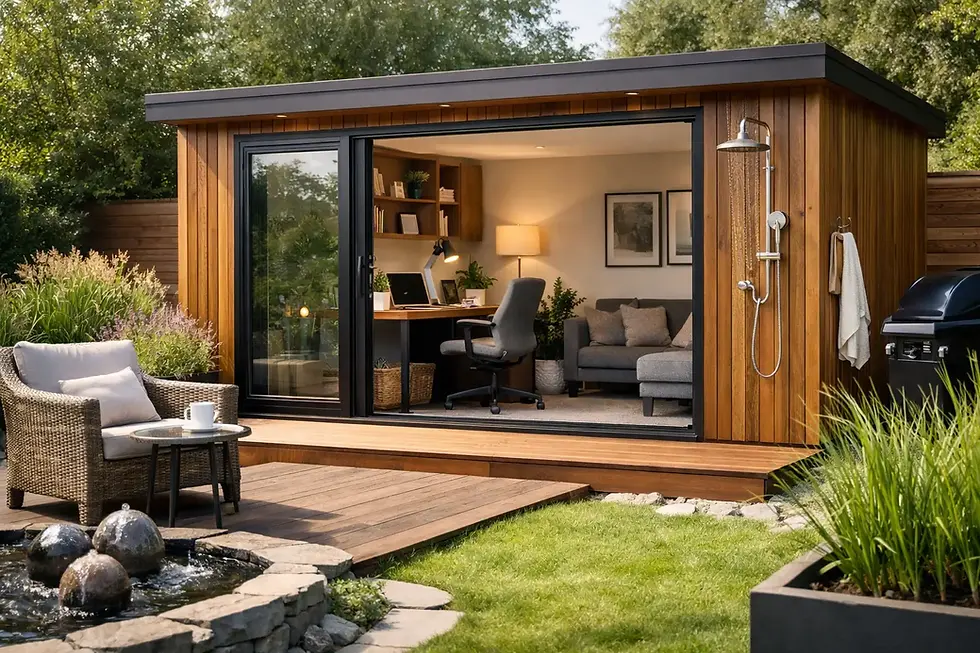
The spare bedroom worked for a while. Then the video calls got louder, the paperwork spread, and the line between work and home started to blur. A custom home office garden room solves a very specific problem - it gives you a place to work properly, close to home but separate from it.
For many homeowners, that separation is the real value. You are still on your property, still only a few steps from the house, but your working day has a clear beginning and end. That matters just as much as desk space or broadband speed. A well-designed garden office should feel calm, comfortable and permanent, not like a compromise tucked at the bottom of the garden.
Why a custom home office garden room works better
The reason bespoke design matters is simple: no two households use space in exactly the same way. One client may need a quiet room for focused work and client calls. Another might want a dual-purpose space that functions as an office during the week and a reading room or studio in the evening. Some need built-in storage to keep documents out of sight. Others care more about glazing, natural light and views into the garden.
An off-the-shelf building can look appealing at first, but standard sizes and fixed layouts often create small frustrations that become obvious once you start using the space every day. The desk does not sit where you need it. The windows bring glare to your screen. Storage is an afterthought. Heating feels inadequate in winter. A custom build lets the room respond to your routine rather than forcing your routine to adapt.
That is especially important if you expect the building to add long-term value to your property. A garden office should feel like part of the home, not an add-on. Proportions, materials, internal finishes and landscaping all affect whether the final result looks purposeful and well integrated.
Start with how you actually work
Before choosing cladding colours or door styles, it helps to look honestly at your day-to-day needs. If your job involves frequent online meetings, privacy and acoustics deserve proper attention. If you spend long hours at a desk, comfort becomes a build issue as much as a furniture one. Insulation, ventilation, lighting and temperature control all shape how usable the room is across the year.
Think about what has not worked inside the house. Noise from family life, poor posture at the kitchen table, weak Wi-Fi in certain rooms, and a lack of storage are common frustrations. A custom home office garden room should solve those pain points rather than simply moving them outside.
Size is another area where it pays to be realistic. Bigger is not always better. A room that is too large for its purpose can feel wasteful and more expensive to heat, light and furnish. Too small, and you lose the sense of ease that makes a dedicated office worthwhile. The right footprint depends on whether you need a single workstation, space for two people, room for client meetings, or flexibility for other uses.
The details that change daily comfort
Natural light is usually high on the list, but more glass is not automatically better. South-facing glazing can create overheating and screen glare unless the design accounts for solar gain. Window placement should support your working position, not fight it.
Thermal performance matters more than many people realise. A garden office is only as good as its coldest morning in January and its hottest afternoon in July. High-performance building systems, including well-insulated walls, roof and floor construction, make the difference between a room that looks good and one that genuinely works every day. This is one reason many bespoke builders favour SIP panels, which offer strong thermal efficiency alongside structural strength.
Ventilation is equally important. In a tightly built room, fresh air needs to be considered from the start. Without it, even a beautiful office can become stuffy during long working hours.
Designing a garden office that suits your garden
A successful office does not just fit your work. It fits your plot. The shape of the garden, the position of neighbouring properties, existing trees, changes in level and the relationship to the house all influence the design.
Placement affects far more than appearance. Put the building too close to the house and you may lose the sense of retreat that makes it attractive. Put it too far away and it can feel disconnected, especially in poor weather. Orientation also shapes light levels, privacy and how the room sits within the wider garden.
The best projects consider the building and landscape together. Paths, planting, lighting and surrounding finishes should not feel like an afterthought. If construction disturbs the garden, that area should be restored properly so the finished space feels settled from day one. This is where an end-to-end approach has real value, because the office itself is only part of the final result.
Planning and practicalities
Planning permission depends on the size, height, location and intended use of the building, so there is no sensible one-size-fits-all answer. Many garden rooms fall within permitted development, but not all. If your property has specific restrictions, or if the building is intended for use beyond incidental garden purposes, early advice matters.
Power, data and access should also be planned properly rather than improvised during installation. Reliable electrics, heating provision and strong connectivity are basic requirements for a professional workspace. If you are investing in a premium office, these should be integrated into the design from the beginning.
What good build quality really looks like
From the outside, many garden rooms can appear similar in photos. The difference is usually in what you do not immediately see. Substructure, insulation, airtightness, moisture control, material quality and installation standards all affect how the building performs over time.
A custom home office garden room should feel solid, quiet and well finished. Doors and windows should operate smoothly. Internal surfaces should look crisp and intentional. The room should stay comfortable without needing constant adjustments to heating or ventilation. These are the signs of a building that has been designed and built with care.
Durability matters too. A garden office is exposed to changing weather throughout the year, so exterior finishes need to be chosen for both appearance and longevity. Sustainable material choices can also be part of that conversation, especially for homeowners who want a lower-impact build without compromising on quality.
For clients who value technical confidence as much as design, construction methods and energy performance are worth discussing in detail. A supplier who can explain thermal build-up, structural integrity and compliance issues clearly is usually better placed to deliver a room that performs as well as it looks.
The value of a managed process
One of the biggest concerns for homeowners is not the idea of a garden office itself. It is the process of getting one built. Design decisions, permissions, site preparation, installation, interior finishes and making good the surrounding garden can feel like a lot to coordinate.
That is why a fully managed service tends to appeal to busy households. It reduces the risk of gaps between stages and gives you clearer accountability from concept through to completion. Design consultation and 3D modelling can be particularly helpful early on, because they allow you to test layouts, proportions and finishes before work starts on site.
For homeowners in Oxfordshire, this kind of joined-up delivery is often what turns a good idea into a practical investment. At Unique Garden Retreats, the focus is not just on constructing the building, but on shaping a room that feels tailored, performs well and sits comfortably within the property as a whole.
A custom home office garden room is an investment in how you live
There is a financial element to any home improvement, but most people feel the benefit of a garden office in more immediate ways. Work becomes more focused. Home feels less crowded. The day has better structure. And because the room is designed around your needs, it stays useful beyond the current moment.
That flexibility is part of the appeal. Today it may be your office. In time, it could become a study space for children, a creative studio, a treatment room or simply a quiet place to step away. Bespoke design allows that future value to be considered from the start.
If you are thinking seriously about a garden office, it is worth treating it as part of the home rather than a detached extra. When the design is thoughtful, the build quality is high and the process is properly managed, the result is not just a place to work. It is a space that makes home life run better.


Comments